
![c9614b67-518f-4223-bb61-af7036e3c8ec [Converti]_edited_edited.png](https://www.ocsport.com/en/_media/f7bdc2_77f92f9ee19241c0b81271f2a8ad41da~mv2.png/v1/fill/w_71,h_100,al_c,q_85,usm_0.66_1.00_0.01,enc_avif,quality_auto/f7bdc2_77f92f9ee19241c0b81271f2a8ad41da~mv2.png)
Sport has its own rhythm, and so does Nature: our path towards regenerative events.
In the beginning, there is NATURE . Autonomous. Untamed. In the beginning, there is our PASSION . Vibrant. Unifying.
We carry within us its rough edges and rhythms, with the conviction that our events must adapt to the cycles of the world that welcomes us. For sport to remain extraordinary, it must now be intertwined with commitment.
Faced with climate challenges, we have chosen to go beyond the sole framework of competition to affirm our role as a committed stakeholder in local communities. Our mission is clear: to transform sporting events into a lever for sustainable change.
A carbon strategy driven by excellence
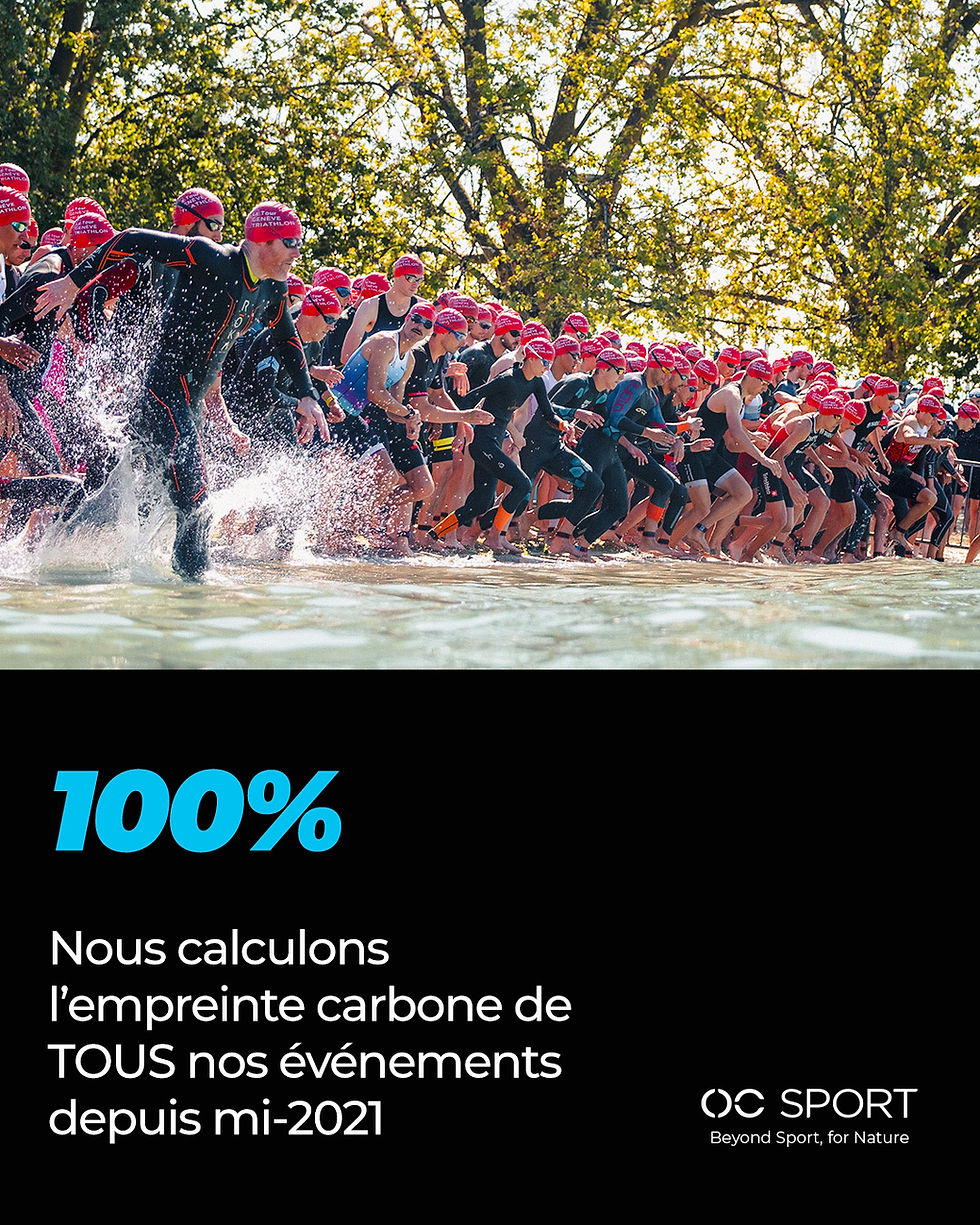
Our approach is not simply a matter of intention; it is the result of rigorous planning. Starting in 2021, we structured our actions with the support of Blueshift, before entrusting Carbone 4 with the development of a precise methodology for calculating our carbon footprints. Whether it's sailing or outdoor events, every data point has been analyzed since mid-2021 to identify our real areas for improvement.
This rigorous approach allows us to maintain an ambitious course: reducing greenhouse gas emissions from our outdoor events by 33% by 2030 compared to 2022. This trajectory is inspired by the French National Low-Carbon Strategy (SNBC) and the framework of the Net Zero Initiative (NZI). However, we know that reduction alone is not enough. For the unavoidable portion of emissions, we refuse to remain inactive. At OC Sport, we don't talk about "offsetting," because carbon emissions cannot be erased. We have chosen the path of actively contributing to global carbon neutrality.
Agoterra: financing the transition at its root
To achieve this ambition, we are collaborating with Agoterra. Their method breaks with traditional carbon offsetting practices, prioritizing the direct financing of the agroecological transition. Agriculture is central to the climate challenge: while it accounts for approximately 20% of global emissions, it is also one of the few sectors capable of storing significant amounts of carbon in soils.
The principle is simple yet powerful: select local farms and allocate funding for the implementation of regenerative practices. This contribution approach doesn't claim to offset our emissions, but it provides concrete support to farmers committed to carbon sequestration and biodiversity restoration. It's a solidarity-based investment for those who nourish the land and protect our shared future.
Our commitment to Agoterra is a long-term effort that is already bearing fruit. Since 2022, this partnership has enabled us to support seven farms in their sustainable transformation, both in France and Switzerland. This historic collaboration has resulted in 1,429 tons of CO2e avoided or sequestered between 2022 and 2026. Each project is an opportunity for us to strengthen the deep ties that bind us to the local communities and to demonstrate that the events industry can be profoundly responsible.
When our marathons come to Fay-de-Bretagne
Today, the Abalone Marathon of Nantes and the Amarris Côte d'Amour International Marathon are joining forces for a flagship project in Loire-Atlantique. Less than 50 km from our finish lines, we are supporting a farm in Fay-de-Bretagne. On this 137-hectare farm dedicated to dairy cattle breeding and cash crops, the farmer has committed to a project to reduce his carbon footprint, aiming to generate 172 potential carbon credits by 2028.
To achieve this environmental performance, three major agronomic levers are activated on the farm:
Food self-sufficiency and the replacement of soy
Soybean meal, which is imported in large quantities, is often synonymous with deforestation and emissions linked to international transport. By replacing it with locally grown rapeseed or sunflower, farmers drastically reduce the carbon intensity of their herd's feed while securing their supplies.
The lengthening of the productive period
Thanks to rigorous technical monitoring of growth and reproduction, the farm optimizes the age at first calving. By reducing the number of unproductive animals on the farm, methane emissions per liter of milk produced are mechanically reduced, without compromising animal health.
Soil care and multispecies grasslands
Establishing temporary grasslands composed of several plant species transforms the soil into a veritable carbon sponge. These practices promote the accumulation of organic matter, improve water filtration, and enrich the surrounding biodiversity.
Investing in Fray-de-Bretagne means taking action for life. The benefits of this project extend far beyond climate change: it's a direct action for water quality, soil health, and the maintenance of a vibrant agricultural sector in our region. At OC Sport, we believe our role is to lead the way. By transforming each race number into an act of commitment to the land that sustains us, we give new meaning to athletic performance. This is how we make a difference, running together for the future of our playing fields.
Regulatory details for the Low-Carbon Label:
The final value of the estimate will only be established after verification of the project by an independent auditor and the signing of an administrative verification decision. The final use of the carbon credits will only be determined after their withdrawal. This communication does not constitute proof of a carbon footprint assessment, greenhouse gas emission reduction efforts, or the company's carbon neutrality.


